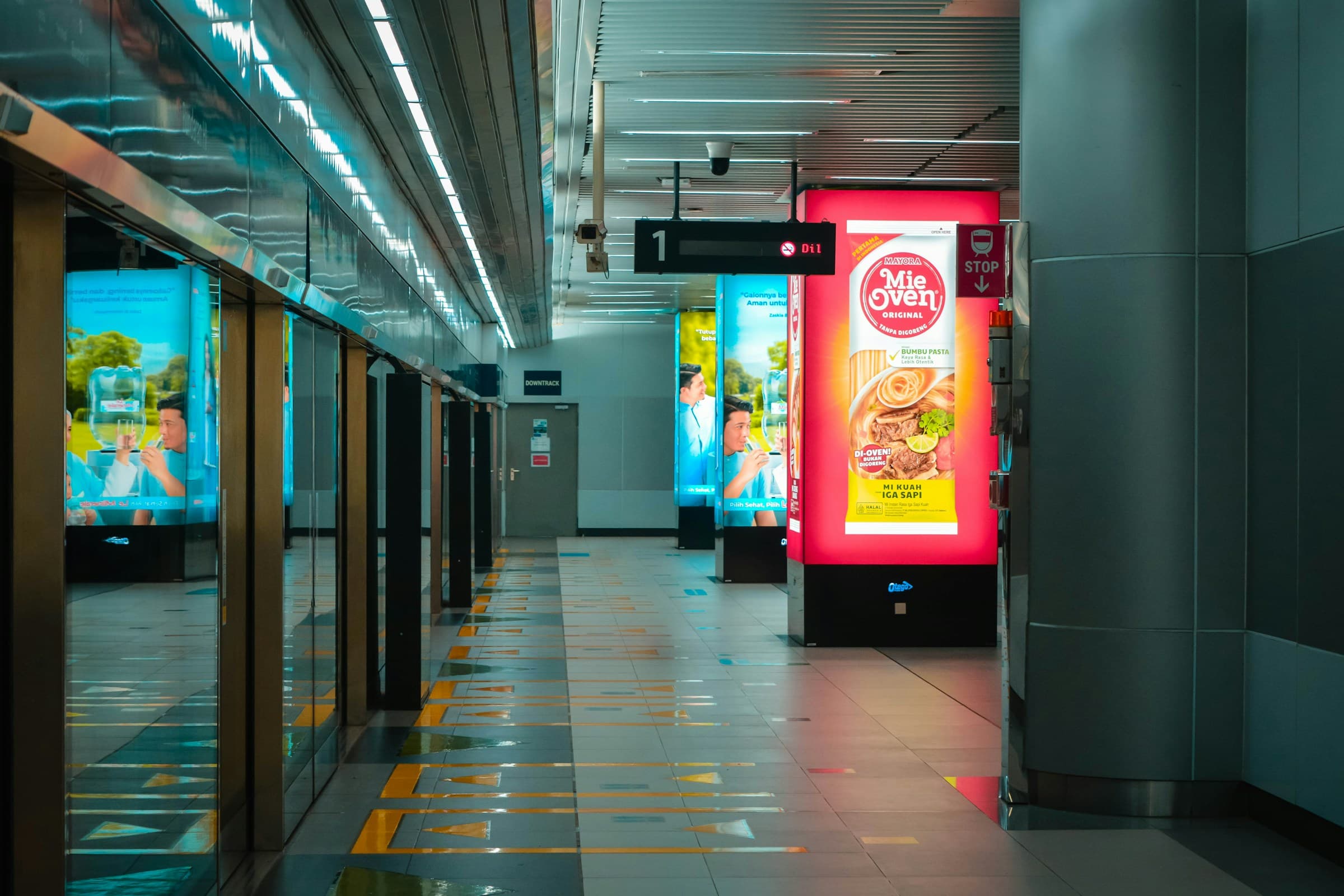
An LED wall is a video surface assembled from LED modules to create a large-format display. It can be built to custom dimensions without the visible bezels associated with LCD video walls.
Size alone is not enough to select one. Pixel pitch, viewing distance, brightness, environment, maintenance and content management determine both quality and cost.
What is an LED wall?
Each module contains an LED matrix that produces the image pixels. Modules are assembled into cabinets and connected to a video controller. The controller receives a signal from a player or production system and maps it across the surface.
LED wall or LCD video wall?
Direct-view LED can form large, continuous surfaces. An LCD video wall combines monitors and retains a bezel between panels. Viewing distance, required resolution, brightness, space and budget determine the appropriate option.
Pixel pitch
Pixel pitch is the centre-to-centre distance between adjacent pixels, measured in millimetres. A smaller pitch increases pixel density and supports closer viewing, but usually raises cost.
The finest pitch is not automatically the right choice. Start with real minimum viewing distance and content type: small text and fine detail need more density than imagery viewed from far away.
Indoor and outdoor LED walls
Indoor
Close viewing, uniformity, noise, thermal management and comfortable brightness matter indoors. Retail, showrooms, conference rooms and receptions may require finer pitches.
Outdoor
Outdoor systems need brightness appropriate for sunlight, weather protection, a robust structure and thermal management. Permissions, safety and maintenance access must also be considered.
Window and transparent LED
Window installations must address reflections, daylight and distance from glass. Transparent LED retains some visibility through the surface, but transparency, resolution and content quality involve trade-offs that should be tested on site.
Brightness, contrast and refresh rate
Brightness should fit the environment and remain adjustable throughout the day. Contrast, colour calibration and module uniformity are equally important. Screens captured on camera also require careful refresh-rate and controller configuration.
Resolution and content format
Total resolution comes from the surface's actual pixel count, not physical size alone. Content teams need pixel dimensions, aspect ratio and reading distance before producing media. Large text, clear contrast and simple compositions work best when viewers are moving.
Installation and maintenance
The structure must support expected loads while providing ventilation, power, signal distribution and service access. Some modules are front-serviceable; others need rear clearance.
A professional project includes calibration, compatible spare modules, monitoring and a process for replacing components with limited downtime.
How much does an LED wall cost?
Cost depends on area, pixel pitch, indoor or outdoor use, brightness, module technology, controller, structure and installation. Player hardware, cabling, design, content, power and maintenance also matter. Physical dimensions alone are not enough for a valid comparison.
Buying a used LED wall
Check uniformity, operating hours, module batches, failed pixels, power supplies, spare availability and controller compatibility. Mixed module batches can create colour differences that are difficult to calibrate.
Managing LED wall content
A permanent LED wall needs a player and digital signage software. The platform schedules playlists, campaigns and dayparts, updates content remotely and monitors device status.
See how Quiwe manages digital signage and LED walls across one or more locations.
Pre-purchase checklist
- Minimum and average viewing distance.
- Dimensions, aspect ratio and required resolution.
- Indoor or outdoor lighting conditions.
- Content type and update frequency.
- Front or rear service access.
- Structure, power, network and safety.
- Software, player and remote monitoring.
- Support and spare-part availability.
Frequently asked questions
Which pixel pitch should I choose?
It depends primarily on minimum viewing distance and content detail. Validate the choice with a simulation or physical sample.
Can an LED wall show different content during the day?
Yes. Digital signage software can schedule content, campaigns and dayparts.
Is an LED wall the same as a video wall?
The terms overlap, but “video wall” often refers to tiled LCD panels, while an LED wall uses direct-view LED modules.